Sorry, but you do not have permission to view this content.
Gardening in the highlands
Growing Food
So you’re a flower grower, not a vegetable grower? Did you know that vegetables are actually easier to grow, taste better than grocery store purchases and do not have poisons on or in them (unless you do it). The seeds are cheaper than nursery plants, though granted your produce will be more expensive than in-season store bought vegetables when you consider your time and energy spent – but much more satisfying to eat.

Do not picture acres of row on row of vegetables which means you must harvest, clean, freeze and store vast quantities of produce. Eating cabbages, beans and potatoes until you turn green. No. Simply interplant only your favourites amongst your flowers. Perhaps a pepper or tomato plant. A few radishes, beets, swiss chard or red Russian kale. (In France I saw dill waving in the breeze interplanted with the flowers in the boulevards and rosemary hedges.)
Seed companies now sell many vegetables that grow only to mini sizes. You could even have little carrots in your planters so that you have pretty feathery green leaves. Consider that garlic is a companion plant to roses. Since the former must be planted in the fall you can get it into the ground when you hill up those roses. A 12 inch pot of mesclun (mixed lettuces) is very attractive and will supply you with plenty of salads. Just keep picking those outside leaves and remove any blossom stems.
Vegetables are healthy food. They are better tasting than lilac blossoms, violets and day lily flowers. But I must admit nasturtium leaves should be given a chance by dedicated vegetable growers.
Check out some of our articles on growing food and have fun!
Gardening in the Highlands
As many northern gardeners will agree there are challenges to gardening in the highlands. The impulse to keep trying speaks to the doggedness and persistence of the type of character who make this region their home or cottage.
As a gardener you’ll be up against:
- Long, cold winters with drying winds
- Variable summers of hot dry or cool wet weather
- Short growing season and cool nights
- Blackflies and mosquitoes
- Nutrient poor and thin soils
- No municipal water or limited well water
- Pests like deer, bear, beaver, and turtles
- Fewer sources of information for northern gardeners
There are benefits of gardening in the Highlands. There are the spectacular views and the ready-made stunning natural backdrop to one’s garden. You’re certain to have an upper story of native trees, an understory of native shrubs and herbaceous plants, and the contrast of a glittering lake, a burbling creek or an imposing rocky outcrop.
The Highlands are part of the Algonquin dome with the contour of the land sloping from a high point downwards to the east, west and south. The northern part of the county, often called the Algonquin Park Region is marginally cooler, dominated by coniferous forests, and poorer soils. The central and southern parts of the county called the Haliburton Slopes benefit from areas of underlying sedimentary limestone. Limestone contains calcium which can neutralize acid and benefit plants. If you happen to garden in one of these areas you have a bit of an edge. In general however Haliburton soils are acidic with a ph. of 6 or less and that’s because the subsoil is composed of ground-up granite rock of the Precambrian shield.
For information about growing zones please click here.
Canada’s most recent Plant Hardiness Zone map takes a wide range of climate variables into account, like minimum winter temperatures, maximum temperatures, rainfall, snow cover, wind, and elevation. In Canada, there are 10 zones, which are numbered from 0 to 9. The higher the zone number, the warmer the climate. Haliburton County is generally considered to be zone 4.
There may also be areas of exception or ‘micro climates’. Factors that contribute to microclimates may be nearby bodies of water, presence of concrete or stone, slopes, soil type, vegetation, or structures. For example, plantings close to a house that are sheltered from northern winds will do well so you might experiment with a plant rated for a warmer zone, like a zone 5. Read the plant tags when you are buying new plants to ensure they will survive year after year.
Beware of imported plants that have the US hardiness zone information on the tags. This is not equivalent to Canadian hardiness zones. As a general rule of thumb gardeners can simply add one zone to the designated USDA zone. For example, USDA zone 4 is roughly comparable to zone 5 in Canada. Buying locally and asking questions at your local garden centre will help alleviate this confusion.
If you want to overwinter perennials outdoors in containers, it’s best to sink them into the ground. This will protect your planter and the plants.
Shoreline Restoration
The ribbon of land between the lake and cottage has undergone monumental changes since lake development began. Many cottage owners removed the natural vegetation at the shoreline in an attempt to urbanize the area. We now understand that this has disturbed the natural environment for wildlife as well as reducing the water quality of the lakes with serious repercussions for human health.
Shoreline protection and an understanding of how it affects waterways is critical for a variety of wildlife species including spawning fish, turtles and nesting waterfowl as well as terrestrial song birds and small mammals. A dense strip of native vegetation is an important buffer filtering snow and water runoff and preventing soil erosion and providing a continuous wildlife corridor.
Experts agree that preserving and restoring cottage shorelines with native vegetation is the best solution for water quality and long-term shoreline stability. This would be the way nature kept shorelines stable and our lakes and streams clean long before the impacts of human development. Native plants are those that occur naturally in a region in which they evolved. They are the ecological basis upon which life depends, including mammals, birds and people. Without them and the insects that co-evolved with them, local birds cannot survive. Native wildlife of all kinds is reduced when the land along the shoreline is paved, turfed, ornamented and exposed. Clear-cutting vegetation, creating steep slopes or mowing to the water’s edge come with consequences.
Sourcing native plants is a lot easier than it used to be. A list of native plant nurseries and resources is provided at the end of the document. The use of fertilizers encourages weeds to the detriment of native plants. Pesticides are detrimental to all living things including humans, aquatic and terrestrial life.
We have created a document that attempts to bring together in one place a description of many common native species that will grow in the Highlands (Zone4), including those that are likely to be available from area nurseries. This revised document also includes the native insects and wildlife that are attracted to native flora as well as some edible and medicinal information about the plants.
This document can be used to help property owners identify the native plants that are already growing on their land so they can ‘preserve’ them and secondly to help property owners choose which natives to purchase and plant in order to ‘restore’ their property.
Download PDF Version Here
Gardening in Zone 4
Canada’s most recent Plant Hardiness Zone map takes a wide range of climate variables into account, like minimum winter temperatures, maximum temperatures, rainfall, snow cover, wind, and elevation. In Canada, there are 10 zones, which are numbered from 0 to 9. The higher the zone number, the warmer the climate. Haliburton County is generally considered to be zone 4.
 There may also be areas of exception or ‘micro climates’. Factors that contribute to microclimates may be nearby bodies of water, presence of concrete or stone, slopes, soil type, vegetation, or structures. For example, plantings close to a house that are sheltered from northern winds will do well so you might experiment with a plant rated for a warmer zone, like a zone 5. Read the plant tags when you are buying new plants to ensure they will survive year after year.
Beware of imported plants that have the US hardiness zone information on the tags. This is not equivalent to Canadian hardiness zones. As a general rule of thumb gardeners can simply add one zone to the designated USDA zone. For example, USDA zone 4 is roughly comparable to zone 5 in Canada. Buying locally and asking questions at your local garden centre will help alleviate this confusion.
If you want to overwinter perennials outdoors in containers, it’s best to sink them into the ground. This will protect your planter and the plants.
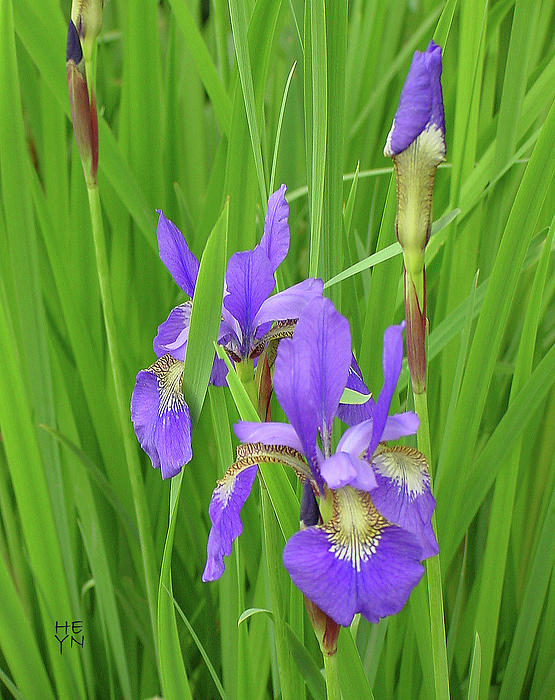
Blue Flag Iris
Blue Flag Iris (Native Ontario Wildflower)
Other Common Names: American Blue Flag, Dagger Flower, Flag Lily, Larger Blue Flag, Multi-coloured Blue Flag, Poison Flag, Snake Lily, Water Flag
French Names: Iris versicolore
Habitat: Marshes, shallow water, preferring sun to part shade and wet feet
Flowers: Its deep blue flowers bloom in July atop stems that reach 60-90 cm.
- Perennial that spreads by fleshy rhizomes
- Ripe seed pod will split open and release seeds
- Muskrats will not eat the rhizomes
Irises make an attractive display in shallow water
All parts of the plant are toxic