• Skip to primary navigation
  • Skip to main content

Haliburton County Master Gardeners

Gardening in Haliburton County

sign up
site search
  • Ask a Question
    • MG Questions Answered
  • Request a Consult
  • Resources
    • Garden with Nature
      • For Your Property Including Shorelines
      • Go Wild
      • Invasives
      • Native Plants & Native Shorelines
      • Sunny Sites
      • Trees
      • Woodland
    • Gardening for Guilty Pleasure
      • Perennials
      • Planning and Design
    • Growing Food
      • Fruits
      • Herbs
      • Native Edibles
      • Pruning and Other Practices
      • Vegetables
      • Soil
    • Native Plants
      • Selection of Native Plants for the Highlands
    • Zone 4 Challenges
      • Pests
      • Tips
      • Wildlife
    • Useful Links
      • Canoe Radio Podcasts
      • County Life Magazine
      • MGOI Website
      • Videos
  • Guidebook
  • About
    • How to Become a Master Gardener
  • What’s On
    • Events Calendar
    • Butterflyway Project
    • Stepping into Nature
  • Buy Local
  • Contact
  • Facebook logo
  • YouTube logo
  • Printer icon graphic

Growing Food

Components of Soil

December 19, 2025

Mineral soils consist of four major components:

1. Mineral Materials

  • sand, silt and clay are the 3 major components of the mineral fraction of soil
  • they account for 45%-50% of the total soil volume
  • sand and silt particles are derived from quartz and feldspar
  • gravel and sand can be seen with the naked eye
  • a magnifying glass is necessary to see silt particles
  • clay particles are derived from silica and aluminum oxides

2. Organic Matter

  • consists of dead and decaying plants and animals.
  • is critical for gardening success because:
  • improves the soil’s physical structure
  • holds and releases plant nutrients
  • increases the water holding capacity of the soil
  • increases beneficial organisms in the soil

3. Water and 4. Air

  • are found in the pore spaces between mineral and organic components
  • account for about 50% of total soil volume
  • are essential for the growth of plant roots and soil microbes
  • dissolve most plant nutrients

Soil porosity is a measure of the pore space volume of a given soil:

  • sandy soils have large pore spaces which promote rapid drainage of water and leaching of nutrients and organic matter
  • clay soils contain tiny pore spaces which may impede root growth and water drainage
  • increasing organic matter increases the soil’s porosity and capacity to hold water

Air is pushed out when water comes into the soil from precipitation or irrigation of groundwater. If air is unavailable to plant roots for too long, the plant suffers from lack of oxygen. Some water is used by plants, some is lost through evaporation, and some moves so deep into the soil the plant roots cannot reach it.

Soil Layers (Horizons)

Ontario soils have at least 3 distinct layers that differ in colour, texture, consistency, and structure.

1. Surface Soil

  • contains most of the organic matter and plant roots
  • provides most of the nutrients and water to plants

2. Subsoil

  • consists of small clay particles that are carried down by gravity and rainfall
  • is lower in organic matter
  • provides storage space for water and nutrients
  • helps regulate the soil temperature and air supply of plant roots

3. Parent Material

  • is made up of decomposed rock characteristic of the bedrock
  • influences the soil’s texture, fertility, acidity, and depth

Soil Structure

In each textural class there is a range in the amounts of sand, silt, and clay that can be present. Most surface soils in Ontario fall into five textural classes. Each class name indicates relative amounts of sand, silt and clay in the soil.

Soil Texture Pyramid


1. Silt loam

2. Loam

3. Silty clay loam

4. Sandy loam

5. Clay Loam
Filed Under: Pruning and Other Practices, Soil

Pruning and Maintenance of Gooseberry Bushes

September 15, 2025

General Care:

  • Mulch to conserve moisture and reduce weeds.
  • Water 1 inch per week from spring until after harvest.
  • Every 3-4 years fertilize in early spring with a balanced fertilizer (10-10-10).
  • Can be grown in containers, trained up a trellis, pruned into small trees or maintained as a small shrub.

NOTE: Very sharp thorns. Wear gloves when handling and picking berries.

Pests & Diseases:

  • Susceptible to powdery mildew and fungus.

Winter/Early Spring Pruning Steps (bush still dormant):

  1. Remove dead and diseased wood.
  2. Remove tangled, crossed, overcrowded or branches touching the ground.

Branches that are left, make the following cuts just above an outward facing bud:

  1. Cut back the previous seasons grown by half.
  2. Cut back side branches between 1 and 3 buds from the base of the shoot.
  3. Remove any suckers growing away from the main stem.

NOTE: For established plants, remove canes over 4 years old. Ideal bush has about a dozen canes at any one time, half being new shoots and other half a mix of 2- and 3-year-old canes.

Summer Pruning (mid-June):

  • Pruning of new growth will improve air circulation. Shorten new growth tips to 5 leaves.


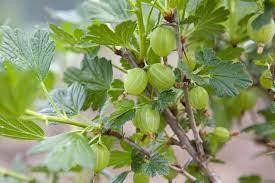
Gooseberry Bush


How to Prune a Gooseberry Bush


Filed Under: Fruits, Growing Food, Pruning and Other Practices

Growing Food

April 25, 2025

So you’re a flower grower, not a vegetable grower? Did you know that vegetables are actually easier to grow, taste better than grocery store purchases and do not have poisons on or in them (unless you do it). The seeds are cheaper than nursery plants, though granted your produce will be more expensive than in-season store bought vegetables when you consider your time and energy spent – but much more satisfying to eat.

Fresh Carrots

Do not picture acres of row on row of vegetables which means you must harvest, clean, freeze and store vast quantities of produce. Eating cabbages, beans and potatoes until you turn green. No. Simply interplant only your favourites amongst your flowers. Perhaps a pepper or tomato plant. A few radishes, beets, swiss chard or red Russian kale. (In France I saw dill waving in the breeze interplanted with the flowers in the boulevards and rosemary hedges.)

Seed companies now sell many vegetables that grow only to mini sizes. You could even have little carrots in your planters so that you have pretty feathery green leaves. Consider that garlic is a companion plant to roses. Since the former must be planted in the fall you can get it into the ground when you hill up those roses. A 12 inch pot of mesclun (mixed lettuces) is very attractive and will supply you with plenty of salads. Just keep picking those outside leaves and remove any blossom stems.

Vegetables are healthy food. They are better tasting than lilac blossoms, violets and day lily flowers. But I must admit nasturtium leaves should be given a chance by dedicated vegetable growers.

Check out some of our articles on growing food and have fun!

Filed Under: Growing Food, Pruning and Other Practices, Tips, Vegetables

Goldenrod (Solidago canadensis)

November 16, 2023

Excerpt from OMAFRA Publication 505 ‘Ontario Weeds’

It is essential that Goldenrod, Solidago spp., [verge d’or, solidage], not be confused with Common ragweed. Several species of Goldenrod occur throughout Ontario in meadows, pastures, woodland, river flats and roadsides, and have very conspicuous bright yellow inflorescences during the ragweed hayfever season of late summer and autumn. Goldenrods do produce pollen but only in small quantities, and their pollen is heavy and sticky. It is not carried on the wind and the plants are pollinated by insects. Because Goldenrod pollen is not carried on the wind, it must not be blamed as the source of irritation for ragweed hay fever sufferers.

Common ragweed is the most important cause of hay fever during August and September. Although inconspicuous and not recognized by most people, the tiny male flower beads hanging on their slender stalks produce huge quantities of very light pollen. As the pollen falls from these hanging flowers, it is caught by the wind and may be carried for distances greater than 200 km (125 miles). Hay fever sufferers, therefore, may be affected by pollen from ragweed plants far away.

  • Easy to grow and easy to pull out
  • Available in nurseries as Solidago
  • Beautiful; good for cut flowers
  • Sun; tolerant of dry or wet conditions, Zone 3
  • Attracts butterflies and bees
  • 35-70 cm (1-2 feet) tall and 45 cm (1 ½ ft) wide
  • DOES NOT PRODUCE WIND BLOWN POLLEN OR CAUSE HAYFEVER
  • Blooms late summer and fall
  • Winter interest and seeds for birds


Goldenrod Vs Ragweed

Filed Under: Garden with Nature, Invasives, Pruning and Other Practices, Woodland

Gardening in the Highlands

October 6, 2023

As many northern gardeners will agree there are challenges to gardening in the highlands. The impulse to keep trying speaks to the doggedness and persistence of the type of character who make this region their home or cottage.     

As a gardener you’ll be up against: 

  • Long, cold winters with drying winds
  • Variable summers of hot dry or cool wet weather 
  • Short growing season and cool nights
  • Blackflies and mosquitoes
  • Nutrient poor and thin soils
  • No municipal water or limited well water
  • Pests like deer, bear, beaver, and turtles
  • Fewer sources of information for northern gardeners

There are benefits of gardening in the Highlands.  There are the spectacular views and the ready-made stunning natural backdrop to one’s garden.  You’re certain to have an upper story of native trees, an understory of native shrubs and herbaceous plants, and the contrast of a glittering lake, a burbling creek or an imposing rocky outcrop.

The Highlands are part of the Algonquin dome with the contour of the land sloping from a high point downwards to the east, west and south.  The northern part of the county, often called the Algonquin Park Region is marginally cooler, dominated by coniferous forests, and poorer soils.  The central and southern parts of the county called the Haliburton Slopes benefit from areas of underlying sedimentary limestone.  Limestone contains calcium which can neutralize acid and benefit plants.  If you happen to garden in one of these areas you have a bit of an edge.  In general however Haliburton soils are acidic with a ph. of 6 or less and that’s because the subsoil is composed of ground-up granite rock of the Precambrian shield.  

For information about growing zones please click here. 

Canada’s most recent Plant Hardiness Zone map takes a wide range of climate variables into account, like minimum winter temperatures, maximum temperatures, rainfall, snow cover, wind, and elevation. In Canada, there are 10 zones, which are numbered from 0 to 9. The higher the zone number, the warmer the climate.  Haliburton County is generally considered to be zone 4.

There may also be areas of exception or ‘micro climates’.  Factors that contribute to microclimates may be nearby bodies of water, presence of concrete or stone, slopes, soil type, vegetation, or structures.  For example, plantings close to a house that are sheltered from northern winds will do well so you might experiment with a plant rated for a warmer zone, like a zone 5.  Read the plant tags when you are buying new plants to ensure they will survive year after year. 

Beware of imported plants that have the US hardiness zone information on the tags. This is not equivalent to Canadian hardiness zones. As a general rule of thumb gardeners can simply add one zone to the designated USDA zone. For example, USDA zone 4 is roughly comparable to zone 5 in Canada. Buying locally and asking questions at your local garden centre will help alleviate this confusion.

If you want to overwinter perennials outdoors in containers, it’s best to sink them into the ground.  This will protect your planter and the plants.

Filed Under: Garden with Nature, Growing Food, Invasives, Native Plants, Native Plants & Native Shorelines, Pruning and Other Practices, Wildlife

Three Invasive Species to Avoid When Planning your Garden

July 29, 2022

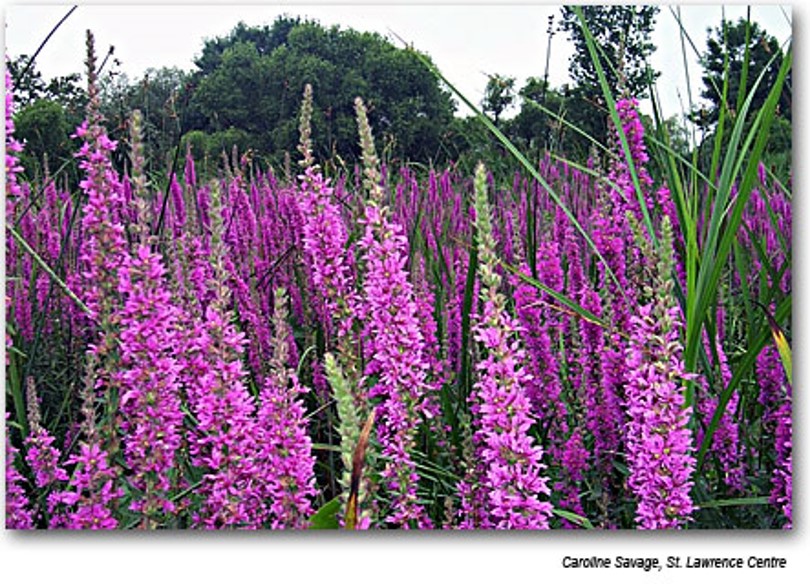
Purple Loosestrife

Scientific Name: Lythrum salicaria L.

Common Name: Purple Loosestrife

Family: Lythraceae (Loosestrife)

Type of Plant: Herbaceous Perennial

Usage: Ornamental

Identifying Characteristics:

Stems & roots: Stout plant, erect (24-48in); 4 angled stem can be smooth to fuzzy; long, well-established tap root

Leaves: Smooth, opposite (2 per node) or whorled (3 per node); narrow to narrowly oblong and heart shaped at base; 1.25-4 in long, attach directly to stems; upper leaves & those in the inflorescence alternate (1/node) & smaller than lower leaves

Flowers: Magenta – pink, tightly clustered, dense, terminal spikes from 4-20in; sepals united into a column with 8-12 prominent green veins & ending in several, long, thin, pointed lobes; 5-7 petals approx. 1/4in long; several stamens & 1 pistil; small seedpod. Bloom late June – mid Sept. Many garden species previously thought to be sterile can produce seeds by cross pollination with wild & other species, increasing the opportunities for spreading

Habitat: In the wild – wetlands, sedge meadows, open bogs. Can also occur along streams, riverbanks, lake shores. Opportunistic in areas with recent soil disturbance. Grows best in highly organic soils in full sun

Invasive Potential: Introduced from Europe. 2.7 million seeds per plant annually, highly invasive in wetland areas through wind, birds, animals & humans. Readily establishes itself, crowding out native species. Decrease in biodiversity has far reaching ecological implications including displacing plants & animals, eliminating food & shelter for wildlife, degrading native wetlands, reducing habitat for waterfowl. Native to Eurasia

Control: No effective method except in small, localized growth area where it can be intensively managed. Isolated areas, uproot plant by hand ensuring the removal of all parts of plant including all roots

Other methods of control: cutting, burning where permitted, herbicide application although herbicides can destroy other nearby plants

Biological control using root weevil (Hylobius transversovittatus), 2 specie

s leaf eating beetles (Galerucella pusilla & Galerucella calmariensis) have been approved by Canadian government. Research indicate there is little chance of permanent host transfer as these insects only feast on purple loosestrife

Recommendations: Recommended to dig all cultivars of Purple Loosestrife from the landscape and, according to the Manitoba Purple Loosestrife Project, can best be replaced with Spiked Gayfeather (Liatrus); a native plant with pink, purple or white flowers that is an environmentally safe perennial. It requires full sun to part shade, height up to 1.5-2.5m, hardy to CDA zone 3; blooms midsummer to Sept


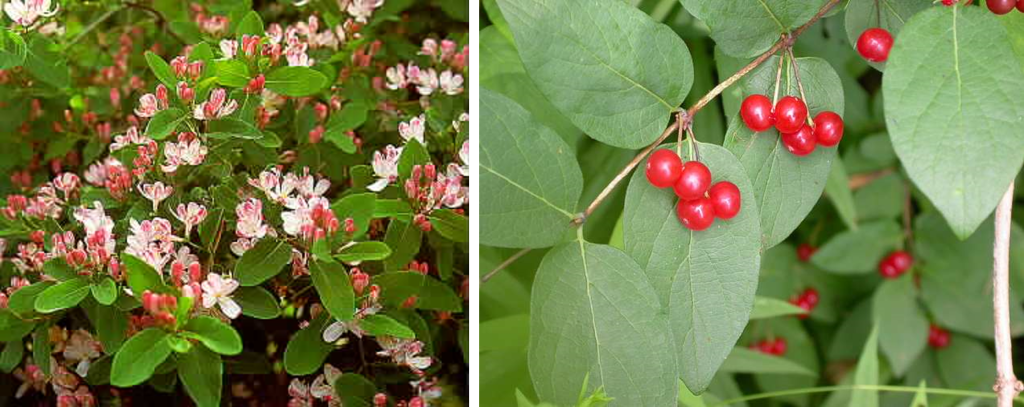
Tartarian Honeysuckle

Scientific Name: Lonicera tatarica

Common Name: Tartarian Honeysuckle

Family: Caprifolaceae (Honeysuckle)

Type of Plant: Flowering Deciduous Shrub

Usage: Ornamental

Stems & roots: Woody, multi-stemmed, upright 2-5m; Branches thin, smooth, becoming hollow; Dicotyledon; bark turns pale grey & shreds with age

Leaves: Opposite, ovate, 3-6cm long, short-stalked & blue-green; Smooth, hairless, bluish-green leaves

Flowers: Usually in 2 pairs developing in axils of leaves at end of branches; 2 leaflets beneath each bud pair, 2 sepals above leaflets; Petals pink to crimson, tubular, 2-lipped, 7-20mm long, fragrant. Blooms May-June. Fruit – abundant berries 3mm diameter, joined at base, ripening orange to red that are available in winter for the birds & other wildlife

Habitat: Adaptable to wide range of habitat; open woods, ravines, woodland edges; prefer moist, sunny areas

Invasive Potential: Moderately invasive in Ontario. Replaces native understory species & ground flora thereby changing vegetation structure; impedes forest seedling & natural tree regeneration; spread by birds & mammals dispersing seed. Native Eastern Asia

Control:
Mechanical: less dense infiltrations – pull ensuring all roots removed
Chemical: systemic herbicides such as Roundup are most effective. Another method is to cut off near ground level & apply herbicide
Biological: There are no current biological control methods available
Recommendations: As with most invasive plants it is best to remove and replace. To contain remove seedlings annually as they appear. Widespread dispersion by birds limits effectiveness. Replacement with North American natives such as Spice bush (Lindera benzoin) – hardy to CDA zone 5 or Viburnum – hardy to CDA zone 3


Glossy Buckthorn

Scientific Name: Rhamnus frangula L.

Common Name: Glossy Buckthorn

Family: RHAMNACEAE (Buckthorn)

Type of Plant: RBC site consider this plant a deciduous tree but many sites consider it a flowering deciduous shrub

Usage: Ornamental

Identifying Characteristics:
Stems & roots: Most often grow in large shrub habit with a few to several stems shooting up from base; shrubs spreading, loosely branched crowns; Bark grey – brown with prominent, lighter-coloured lenticels (pores in the stem of a woody plant allowing exchange of gases between the plant and the exterior)*. Unusual winter appearance with naked, hairy terminal buds & appealing curved twigs with closely-spaced, prominent leaf scars giving the twigs a bumpy outline against a white snowy backdrop. Tree habit reaches 6-9m high and 26cm diameter

Leaves: Thin, glossy, ovate or elliptic leaves, 3.8-7.6cm long; upper leaf surface shiny; lower surface hairy or smooth with margins that are not toothed – a distinguishing feature from the similar common buckthorn

Flowers: Yellow-green, 4 petals develop in clusters of 2-6 near base of petioles. Plant are dioecious (male & female sex organs on separate plants). Fruits small, black berries 0.6cm in diameter appear singly or in small groups in leaf axils. Fruit is poisonous except to European Starling – primary agent responsible for the spread

Habitat: Prefers range of wetland areas such as marshes and bogs but can grow in upland habitats such as forest, wood edges & old fields. In Ontario, primarily near larger populations

Invasive Potential: Invasive locally in Southern & Eastern Ontario. Rapid spread & ability to invade native wetland areas suggest this will become a serious threat in the future. Detrimental effects include: outcompeting native plants for nutrients, light & moisture; degrading wildlife habitat, serving as host to pests such as crown rust fungus

Control:
Mechanical: Remove isolated plants early before seed production, prescribed burns if permitted by law (may need to do this for several years);
Chemical Control: Best during fall season to lessen risk of affecting non-target plants;
Biological Control: No current biological control methods
Recommendations: As with most invasive plants it is best to remove and replace. As with the Glossy Buckthorn, replacement with same North American natives such as Spice bush (Lindera benzoin) – hardy to CDA zone 5 or Viburnum – hardy to CDA zone 3 is recommended


Resources:
* Life Sciences & Allied Applications / Botany definition
Invasive Plants of the US: Plant Conservation Alliance’s Alien Plant Working Group: Environment of Canada: Royal Botanical Gardens: Ontario Food & Agriculture: Ministry of Agriculture, Food & Rural Affairs: Ontario Federation of Anglers & Hunters: Invading Species: Ducks Unlimited; Talk About Wildlife; Alberta:

Filed Under: Garden with Nature, Gardening for Guilty Pleasure, Invasives, Native Plants, Planning and Design, Pruning and Other Practices

  • « Go to Previous Page
  • Page 1
  • Page 2
  • Page 3
  • Page 4
  • Go to Next Page »

coordinator@haliburtonmastergardener.ca

privacy policy

Haliburton County Development Corporation logo


HCMG logo
Member Login
  • Ask a Question
  • Resources
  • About
  • News & Events

Follow us on YouTube badge

  • Newsletter Signup
  • Contact
  • Buy Local

© 2026 HaliburtonMasterGardener.ca   •   Website Development by TechnicalitiesPlus Inc.