• Skip to primary navigation
  • Skip to main content

Haliburton County Master Gardeners

Gardening in Haliburton County

sign up
site search
  • Ask a Question
    • MG Questions Answered
  • Request a Consult
  • Resources
    • Garden with Nature
      • For Your Property Including Shorelines
      • Go Wild
      • Invasives
      • Native Plants & Native Shorelines
      • Sunny Sites
      • Trees
      • Woodland
    • Gardening for Guilty Pleasure
      • Perennials
      • Planning and Design
    • Growing Food
      • Fruits
      • Herbs
      • Native Edibles
      • Pruning and Other Practices
      • Vegetables
      • Soil
    • Native Plants
      • Selection of Native Plants for the Highlands
    • Zone 4 Challenges
      • Pests
      • Tips
      • Wildlife
    • Useful Links
      • Canoe Radio Podcasts
      • County Life Magazine
      • MGOI Website
      • Videos
  • Guidebook
  • About
    • How to Become a Master Gardener
  • What’s On
    • Events Calendar
    • Butterflyway Project
    • Stepping into Nature
  • Buy Local
  • Contact
  • Facebook logo
  • YouTube logo
  • Printer icon graphic

Native Plants & Native Shorelines

Aquatic Plants of the Near Shoreline and Wetlands

May 9, 2023

If you have the good fortune to live close to a marsh you will be able to observe the comings and goings of the most biodiverse ecosystem on the planet. Wetlands are comparable to rainforests and coral reefs for the sheer number of plant and animal species that they support. Some people see swampy land as a breeding ground for mosquitoes with no inherent value. They itch to drain the land, fill the low spots and use it for agriculture, housing or industry. Around the world such practises have changed the climate, released tons of carbon into the air, extinguished untold animal species, created droughts, fouled the water, eroded shorelines and caused destructive and widespread flooding.

There are no bylaws to prevent the filling in of upper wetlands and even those along shorelines in Haliburton County have been allowed to be destroyed. Fortunately, a new Shoreline Preservation By- law will protect some of these shoreline wetlands and upland ponds but still much will remain under protected. Click here to read more about how local laws do and don’t protect forests and wetlands. The township of Minden has had the foresight to demarcate the wetland in the middle of their town as a park and put in a Boardwalk that is popular with walkers and photographers. And it’s a good thing because the damage to roads and properties due to three ‘state of emergency’ flood events in a recent six year period would have been a whole lot worse without the wetland.
The Minden marsh absorbs a great quantity of water during a torrential rainstorm. The water spreads out along low lying areas and the marshes slow and filter the water preventing the banks from overflowing and flooding. These and other marshes help to balance the level of water throughout the year within the Gull River watershed. The Minden Wetland also filters out pollutants and excess nutrients reducing the algae growth in Gull Lake and others downstream. Too much algae growth robs the lake of oxygen which can result in the death of fish and is a sign of a system badly out of balance. No one wants to live on a dead lake.

Value forests and vegetated shorelands
The forested hillsides and shorelands in our region also play a critical role in our health, safety and well-being. Forests filter and regulate the flow of water. Their leaves capture and slow the fall of rain to the forest floor, which acts like an enormous sponge, absorbing up to 46 centimetres (15 in) of precipitation before gradually releasing it to streams and recharging ground water. On average an untouched forest floor can absorb 2/3rds more rain than a cover of suburban turf.
If you have a low marshy area on your property, you could make it an attractive feature instead of filling it in. If it’s in a sunny area, you might want to plant blue eyed grass (Sisyrinchium) or the native bright red Cardinal Flower (Lobelia cardinalis) If it receives shade how about planting a fernery. There are a number of native ferns and other moisture loving plants for sun, shade and the in between. For more plant descriptions please consult the Directory of Native Plants for Your Property including Shorelines as well as considering the list of plants below.

To choose the right plant for the right place we need to understand the shoreline zone and the littoral zone. The shoreline is where water meets the land and this line can fluctuate seasonally and as a result of the Trent Severn management of the dams in the over 600 lakes of Haliburton County. The plants in this zone we’ll call shoreline plants. The littoral zone is the near shore area where sunlight penetrates all the way to the bottom and allows aquatic plants to grow. In this zone we include three types of plants. Emergent plants, Floating plants and submerged plants

Diagram of the four types of aquatic plants:

Four types of Aquatic Plants

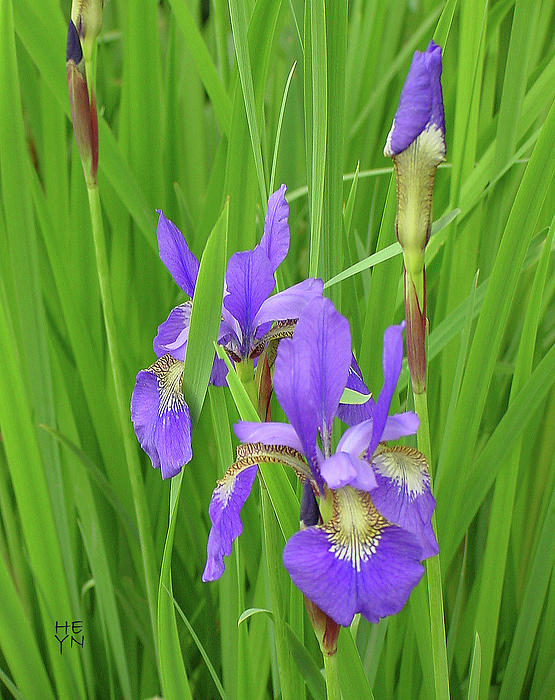
1.Shoreline or Marginal Plants are found where water meets land. They like moist soil and seasonal flooding. (Blue flag iris, some shrubs and trees)
2. Standing Water or Emergent Plants have their roots in the soil under water but grow up and emerge out of the water.
3. Floating Plants float at or near the water surface and have either floating roots or roots in the soil at the bottom (eg. duckweed and lily pads)
4. Submerged Plants are completely underwater and have roots in the soil at the bottom. (e.g. pond weed and bladderwort)

Shoreline Plants are an important food source for pollinators like bees, birds, butterflies and moths. Since these plants grow tall, mammals and invertebrates like frogs use them to hide from predators. You will find descriptions of many plants suitable for shorelands such as the Blue Flag Iris, Meadowsweet, Boneset, Joe Pye Weed, Turtlehead, Swamp Milkweed, sedges, and ferns in the Directory of Native Plants. You will also want to peruse the article on Solutions for Erosion for a good selection of plants that can adapt to both wet and dry conditions.

If you’re looking for a taller ornamental shrub for the shoreline you can’t go wrong with our two native hollies.

Mountain HollyMountain holly (Nemopatthus mucronate) can often be found growing in full sun in wet areas. It can be naturalized in wet woodland landscapes, where it will form dense colonies. It will grow to 2 metres tall and 1 metre wide. The attractive red berries are an important food source for migrating birds and disappear quickly in autumn. Male and female plants are required for fruiting. Full sun required for good fruit production. Propagate by softwood cuttings.
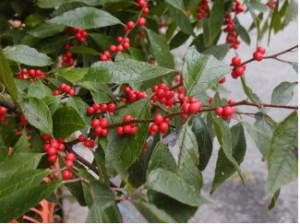
Picture of WinterberryWinterberry (Ibex verticillata) is a holly shrub 1-5 m tall so called because it retains its berries into winter unlike its close cousin the Mountain Holly. In wet sites, it will form a dense thicket, while in dry soil it will grow slowly into a smaller shrub. It has lovely glossy leaves, tiny flowers but beautiful red fruits that provide winter food for the American Robin and other birds. Male and female plants are required for fruiting. Full sun required for good fruit production. Propagate by softwood cuttings. Photo credit: SB_Johnny

Emergent Plants are important in providing a buffer from wind and wave action that can wash out shorelines. Waterfowl such as mallards and wood ducks feast on emergent plants. They also use their sturdy stems and leaves to build nests. Fish and insects also use these plants for cover and food.
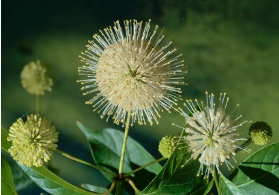
Picture of Common Buttonbush
Plants like Common Buttonbush (Cephalanthus occidentalis) is a real showstopper with its fuzzy, golf ball shaped flowers which appear in August. It’s a fulsome spreading shrub or small tree that needs wet to moist conditions like those found in ponds and marsh areas. It thrives in sun to part sun. Ducks and other water birds and shorebirds consume the seeds and songbirds love the fruit. Butterflies, bees, and insects are attracted to the fragrant, nectar rich flowers. It also provides nesting habitat for songbirds and if we haven’t sold you on this plant yet it is deer resistant.

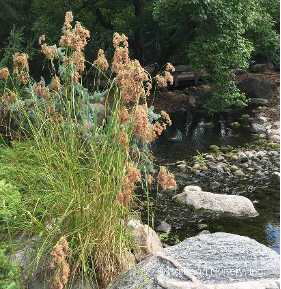
Tawny Bog Cotton (Eriophorum virginicum) is common in sphagnum bogs and wet ditches. This unique sedge is one of many cotton grass cultivars with a flower that has a white to tan bristly appearing but soft, cotton like mass 1 to 2 inches across. It blooms from June to September. The leaves are flat and grass like.
Picture of Wild Calla
Wild Calla

Wild Calla (Calla palustris) forms dense colonies and spreads by rhizomes. Blooming in late spring It has a lovely white flower followed by bright red berries. It can tolerate partial shade and grows from 20-30 cm tall.

Scirpus cyperinus and Scirpus validus are the most common species among the bulrushes. They grow in wet soil, full sun, or light shade. It’s good for erosion control when planted en masse. Bulrush forms a buffer against wind and wave action and protects other less robust aquatic plants to grow. It has a lovely woolly head and not to be confused with cattails.

Sweet Flag (Acorus americanus) grows to 30 cm tall in full sun. It can form stands of sword-shaped, stemless leaves similar to Iris leaves but with an understated furry flower that emerges from a stiff spath. The “sweet” in the name comes from the scent the leaves give off when broken. Rhizomes allow a plant to die back and survive the winter.
Picture of Pickerelweed
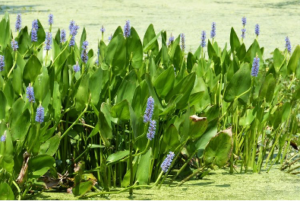
Pickerelweed with small floating Duckweed Photo credit: The Cosmonaut

Pickerelweed (Pontederia cordata) has heart shaped leaves and showy deep blue spikes of flowers grows to 30 cm tall.

Arrowhead (Sagittaria latifolia) The leaf is arrowhead shaped and in mid summer a lovely white flower emerges. It grows in calm waters and its rhizome was eaten by local tribes.

Cattails (Typha latifolia) are widely recognized as a 2-meter-tall water loving plant that bears a brown fruiting head that looks like a hotdog on the top of its study stalk. It’s sword shaped leaves rustle in the breeze and turn yellow brown in autumn. Their root systems help prevent erosion. They provide protection and nesting habitat for many birds, reptiles, insects and animals. Their “nutlet” seed fruits are an important food for many species of insects and that then become food for other species. They also provided important food source for local tribes.

Floating Plants help keep algae in balance by absorbing nutrients, blocking light and cooling the water. These same factors provide an underwater habitat perfect for fish hunting for water insects. They provide landing places for mosquito loving dragonflies and other insects and invertebrates.

Yellow Pond Lily (Nuphar variegate) will do well in quiet or gently flowing waters up to 2 metres deep. The flat oval shaped leaves float on the surface. A single yellow globe-shaped flower borne on a stout stalk proudly protrudes above the water. Propagate by seed or divide the rhizomes in late spring.

White Water Lily (Nymphaea odorata) has flat round leaves that float on the surface of quiet or gently flowing waters up to 2 meters deep. Blooming all summer, the showy flowers are large, fragrant with multiple white pointed petals and a centre of golden stamens. Propagate by seed or divide the rhizomes in late spring.

Duckweed or water lentils (Lemna minor)
This tiny little floating plant can quickly cover the surface of a small pond. It’s valued for improving water quality and it often used to treat wastewater because of its ability to absorb high amounts of nitrogen and phosphorous. It’s also grown commercially for cattle feed because of its high protein (45%) and fat content (4%).

Submerged Plants like Pondweed (Elodea canadensis) are excellent oxygenators that absorb excess nutrients from the water and release oxygen that helps to clean the water and prevent the overgrowth of algae. Fish use this habitat to make nests and to hide from prey while on the hunt. These plants are also food for ducks and muskrat. All rooted plants help keep the sediment at the bottom of a lake and buffer harmful wave action.


Carolyn Langdon, Master Gardeners 2023
Resource:
HHLT Guidelines on Protecting Wetlands
chrome-extension://efaidnbmnnnibpcajpcglclefindmkaj/https://www.haliburtonlandtrust.ca/wp-content/uploads/2022/01/HHLT_WetlandsBooklet-V4-2020-01-011.pdf

Filed Under: Garden with Nature, Native Plants & Native Shorelines

Natural Landscaping Solutions

September 25, 2022

Plants have roots.They have roots that intertwine, roots that mat together, roots that penetrate deeply and anchor around rocks, roots that prevent soil from washing away. Nature has done a pretty good job holding things together since the last ice age 10,000 years ago. Attached to these roots are a variety of remarkable plants, shrubs and trees that have evolved over 10, 000 years with each other and with mammals, insects and avian species to create some pretty extraordinary ecosystems.

More and more landscapers are turning to native plants and methods that mimic natural processes to restore degraded sites along shorelines and in upland areas. If you live on waterfront, you’ll want access to the water to reach a dock or a beach. The ideal is to minimize the amount of native vegetation that you remove to create a path. For level sites a soft path is kindest on the land. For steeper sites, steps or a snaking path may be necessary. A path will act as a water course during heavy rains so top your path with wood mulch to help slow and absorb water. If your slope is very steep and you’re using rock, make it local granite which is available nearby and aesthetically fits in with the surrounding land. Don’t ignore the value of plants when you are putting in hardscapes like steps, patios and retaining walls and wherever practical choose plants over hardscape to solve problems and create esthetic spaces. Place plants close to hard scape features to hold the soil in place and plant them densely.

Picture of Bearberry with red berries.
Bearberry would be a good choice for planting around steps and paths since they are widely available, hardy, low growing, sun loving and thrive in poor sandy soil.

Photo credit Sten Porse CC-BY 3.0plants

Shorelines cloaked in vegetation fare better than properties cleared of shrubs and trees and planted in grass. Steep banks do well planted in Willow shrubs, Speckled Alder, Beaked Hazelnut (Corylus cornuta) and Red Osier Dogwood, named for its red stems. It is the tenacious plant roots of these shrubs that hold the soil in place. These plants have adapted to extreme conditions and will survive periods of flooding and then long periods of little rain. They are deciduous and can be pruned aggressively to maintain views. There are many other plants that can tolerate a range of conditions that make them ideally suited to shorelines and the vagaries of the weather. For other plant choices please peruse the article on Solutions to Erosion .

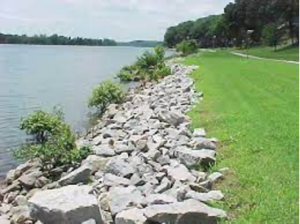
Hard surfaces like steps and retaining walls do nothing to slow the flow of water from the top of a slope or prevent the force of a river or wave action from slowly undermining these structures. Engineers have found that rip rap is not always effective in stabilizing the shore but merely armours it for a period of time. Rip rap does a poor job of absorbing the energy of water and merely deflects waves to the edges undermining neighbouring properties. Placing plants in rip rap to accumulate organic debris from roots can help.

Restorationists are now opting to use vegetation and softer organic materials. In serious cases a steep slope may need to be cut back to reduce the angle and then clothed in coco mat to hold the disturbed soil in place until plant roots spread enough to take over this function. Coconut fiber rolls and mats placed along a shoreline can absorb and redirect water and can be planted so that plant roots can eventually take over.


Picture of Rip Rap
Rip Rap has fallen out of favour

Ideally we want to take care of water before it reaches the shore. And to do that we need to assess the state of the landscape from the shoreline back to your property line. We would need to consider how many buildings and parking areas with impervious surfaces, grass vis a vis a many layered woodland are in place. A landscape of different layers allow light to penetrate to all plants – low perennials, understory, upper canopy.

Erosion has a lot to do with upland management. The ideal is to have the ground water from rainfall and runoff be absorbed, filtered and cleaned before it runs down the slope to the water body. Bio swales, raingardens, and undulations in the landscape can all be used to hold water and give it time to absorb into the ground.
Forests filter and regulate the flow of water. Leaves capture and slow the fall of rain to the forest floor. The ground acts like an enormous sponge, absorbing up to 46 centimetres (15 in) of precipitation before gradually releasing it to streams and recharging ground water. On average an untouched forest floor can absorb 2/3rds more rain than a cover of suburban turf.

Well vegetated upland areas can still offer a view. Deciduous shrubs and trees can be thinned, and branches removed with little effect on the vegetation. It’s called ‘vista pruning’ and looks more attractive than a clear-cut swath down to your lake. Use brush and other available organic matter to build soil to reclaim poor soil areas. It may take a few years for twigs and branches to break down in our temperate zone with our short summers and cool evenings, but you’ll eventually be rewarded with rich, moist soil ideal for planting natives. If you can’t wait, you can make a hole in the brush, add soil and plant. Brush piles also act as habitat for wildlife so you may want to have a succession of soil building projects on the go.

Build swales or ditches and then plant them so that plant roots can take up excess water. A bio swale allows surface water to soak into the earth slowly, rather than flooding or shooting down to the lake. Use rocks, logs and any other natural debris to slow down the flow of water and arrest erosion. Place logs perpendicular to a compacted and steep path to direct water to the sides. Use wood chip mulch on the sloped pathways as it is absorbent and is a soil builder. As tempting as it may be, please avoid planting fast growing invasive ground covers like periwinkle (Vinca) and Goutweed (Aegopodium podagraria).

Plants, with their varied root systems blanket and protect the soil from drying out and from blowing or eroding away. They also aerate the soil and provide nutrients to the soil from decaying foliage. Organic material has the additional benefit of providing texture and nutrients to your soil as it breaks down.
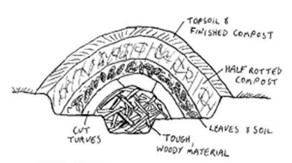
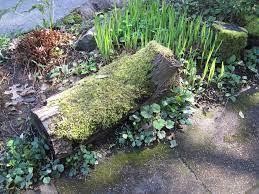
An effective and affordable solution for any terrain but particularly steep slopes is the use of wattles which are simply bundles of organic material, possibly coco rolls. Live stakes and/or steel rods are used to hold the material in place. The live stakes are cuttings taken from shrubs such as willow and dogwood, that quickly set down roots. The use of live stakes can only be used in early spring and the stakes can be bought or cut from existing vegetation before leaf out. Buttonbush, elderberry, viburnum, willow and dogwood are all sold as live stakes. Buy dormant and plant in April/May.

How to obtain plants:
The nursery trade has a very small inventory of native plants, so you’ll have to be creative.
Celebrate what you have, prune, move and enhance.
Transplant or divide from plants on your property.
Collect seed from friends.
Purchase sustainably grown plants
For a list of local landscapers, arborists and nurseries please visit our Buy Local page

Haliburton County Master Gardeners, 2023

Filed Under: Garden with Nature, Native Plants, Native Plants & Native Shorelines, Sunny Sites, Trees

Shoreline Restoration

April 8, 2022

The ribbon of land between the lake and cottage has undergone monumental changes since lake development began. Many cottage owners removed the natural vegetation at the shoreline in an attempt to urbanize the area. We now understand that this has disturbed the natural environment for wildlife as well as reducing the water quality of the lakes with serious repercussions for human health.

Shoreline protection and an understanding of how it affects waterways is critical for a variety of wildlife species including spawning fish, turtles and nesting waterfowl as well as terrestrial song birds and small mammals. A dense strip of native vegetation is an important buffer filtering snow and water runoff and preventing soil erosion and providing a continuous wildlife corridor.

Experts agree that preserving and restoring cottage shorelines with native vegetation is the best solution for water quality and long-term shoreline stability. This would be the way nature kept shorelines stable and our lakes and streams clean long before the impacts of human development. Native plants are those that occur naturally in a region in which they evolved. They are the ecological basis upon which life depends, including mammals, birds and people. Without them and the insects that co-evolved with them, local birds cannot survive. Native wildlife of all kinds is reduced when the land along the shoreline is paved, turfed, ornamented and exposed. Clear-cutting vegetation, creating steep slopes or mowing to the water’s edge come with consequences.

Sourcing native plants is a lot easier than it used to be. A list of native plant nurseries and resources is provided at the end of the document. The use of fertilizers encourages weeds to the detriment of native plants. Pesticides are detrimental to all living things including humans, aquatic and terrestrial life.

We have created a document that attempts to bring together in one place a description of many common native species that will grow in the Highlands (Zone4), including those that are likely to be available from area nurseries. This revised document also includes the native insects and wildlife that are attracted to native flora as well as some edible and medicinal information about the plants.

This document can be used to help property owners identify the native plants that are already growing on their land so they can ‘preserve’ them and secondly to help property owners choose which natives to purchase and plant in order to ‘restore’ their property.

Download PDF Version Here

Filed Under: For Your Property Including Shorelines, Garden with Nature, Native Plants, Native Plants & Native Shorelines, Pests, Sunny Sites, Trees, Wildlife, Woodland

Blue Flag Iris

January 25, 2022

Blue Flag Iris (Native Ontario Wildflower)
Other Common Names: American Blue Flag, Dagger Flower, Flag Lily, Larger Blue Flag, Multi-coloured Blue Flag, Poison Flag, Snake Lily, Water Flag
French Names: Iris versicolore
Habitat: Marshes, shallow water, preferring sun to part shade and wet feet
Flowers: Its deep blue flowers bloom in July atop stems that reach 60-90 cm.

  • Perennial that spreads by fleshy rhizomes
  • Ripe seed pod will split open and release seeds
  • Muskrats will not eat the rhizomes

Irises make an attractive display in shallow water
All parts of the plant are toxic

Blue Flag Iris

Filed Under: Garden with Nature, Gardening for Guilty Pleasure, Native Plants, Native Plants & Native Shorelines, Perennials

Erosion Solutions From Heavy Rain

October 25, 2021

Question: Can you slow water runoff at the top of a slope?

Natural Stone StepsHaliburton County Master Gardener advises you to build a small rain garden at the top of your slope. Add a small berm at the top of and/or mid-way down your slope. Put in a berm of logs, branches, soil and/or rocks to slow down the water running off and to allow time for the rain to absorb and for plant roots to establish. The idea is to place any material that will act to obstruct or slow down the path of water. Organic material has the additional benefit of providing texture and nutrients to your soil as it breaks down.

Clearing a shoreline or hillside of herbaceous plants, shrubs and trees can lead to erosion if not re-planted. Longer, steeper slopes, especially those without adequate vegetative cover are more susceptible to very high rates of erosion during heavy rains than shorter, less steep slopes.

Please remember that a rain garden is not the same as a water garden. There are 5 components to a rain garden:

1. Depression
2. Amended filter bed (see wood log trench below)
3. Berm on the low side
4. Rockery to slow water entering the garden if necessary
5. Plants tolerant of water and long periods of dryness (i.e. 2-3 days of standing water)

Woodlog Trench DiagramNatural Wood Log Berm


A rain garden is a low tech solution for a location that periodically gets inundated with water. For example some downspouts can’t handle the quantity of rain and the spill over can cause existing vegetation to die and erosion of soil. Hard surfaces channel water during torrential rain and spring snow melt events that cause erosion particularly on steep slopes. A rain garden and berm might be an affordable solution. A 5X10 foot rain garden 6 inches deep is equivalent to 11 rain barrels.

Dig your rain garden (12-18” deep) and fill with a combination of logs, branches, and wood chips at different stages of decomposition. Add native soil and locally composted organic matter. Plant. Remember good humid soil will store a lot of water. Other practices for extreme sites is to mulch deeply, contour the soil, plant native species adapted to the location and plant densely.

Select the Right Plants

In this situation plants that can withstand short periods of flooding and long periods of dryness are required. Xeriscaping plants i.e. those that tolerate drought won’t do well in a condition that includes extreme wet and extreme dry. Likewise plants that require constant moisture will not do well.

Do favor native over non-native plants and do not plant fast growing invasive plants however tempting that might be to stabilize your slope.

The following native Ontario plants can tolerate moist and dry soil:

Aster (Aster spp.)
Bergamot, Wild (Monarda fistulosa)
Black-Eyed Susans (Rudbeckia hirta)
Blazing stars, Rough (Liatris aspera)
Evening Primrose (Oenothera biennis)
Bittersweet (Celastrus scandens)
Goldenrod (Solidago spp.)
Verbena (Verbena spp.)
Yarrow (Achillea millefolium)
Sweet gale or bog myrtle (Myrica gale L) Myricaceae (Wax-myrtle or bayberry Family)
Non invasive ornamental grasses, native sedges (they look like grasses and can tolerate some shade), and rushes. Hierochloe odorata or Sweetgrass
Marginal Woodfern (Dryopteris marginalis) can tolerates mid-summer drought if planted in the shade.
Butterfly Weed (Asclepias tuberosa) a Zone 3 Ontario Native that is heat and drought tolerant,
Liatris aspera or Blazing Star, another Ontario native,
Schizachyrium scoparium or Little Bluestem (Ontario native)
Highbush Cranberry (V. trilobum or V. opulus var. americanum). This native shrub likes to grow in open, wooded, somewhat poorly drained locations. In the ideal location, cranberry can become very wide, often three meters or more, and reach about the same height.
Low bush Cranberry or Squashberry (V. edule)
Nannyberry (Viburnum lentago) will grow almost anywhere including shade, but they take on their best form in full sunlight. In full sun their fall leaf colors will be a vibrant purple-red.
Common or Eastern Ninebark up to 3 m, spring flower cluster, berries

Credit Valley Conservation planted native plants in their rain garden. They chose the following plants because they were widely available at local nurseries: Red Osier Dogwood, New England Aster, Tall Meadow Rue, Black Eyed Susans, Canada Anemone.  Shade-tolerant native plants included: Common elderberry, Sensitive Fern and Heart leaved Aster.

A dense base of day lilies and irises will give you a fibrous root system. While they aren’t native they are often planted in a naturalized landscape.

To buy plants please try your local garden center and check other sources listed in our list of suppliers and services here.


Article Sources

Credit Valley

Toronto Zoo

For additional plant selection please see Appendix C, List of Plants tolerating both wet and dry conditions. University of Guelph

Filed Under: Garden with Nature, Gardening for Guilty Pleasure, Native Plants & Native Shorelines, Planning and Design, Tips

  • « Go to Previous Page
  • Page 1
  • Page 2

coordinator@haliburtonmastergardener.ca

privacy policy

Haliburton County Development Corporation logo


HCMG logo
Member Login
  • Ask a Question
  • Resources
  • About
  • News & Events

Follow us on YouTube badge

  • Newsletter Signup
  • Contact
  • Buy Local

© 2026 HaliburtonMasterGardener.ca   •   Website Development by TechnicalitiesPlus Inc.